
An Extremely Repetitive Plot Twist
An unpopular president, a weak economy, and a war walk into a midterm election...

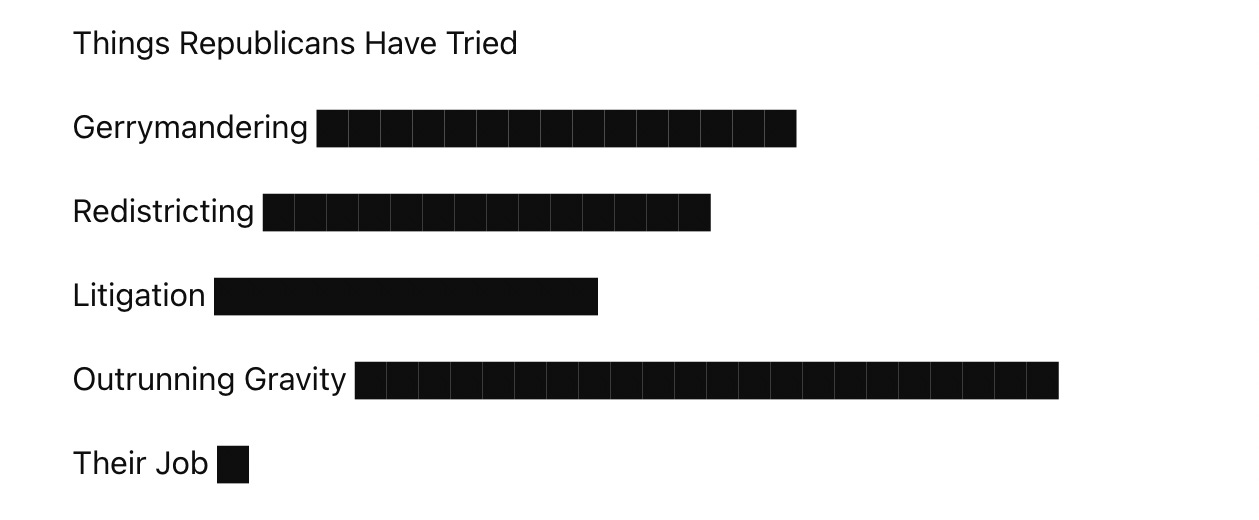
Patterns, unlike predictions, don’t require a crystal ball. They require a library.
Since 1946, the president’s party has lost House seats in 18 of 20 midterm elections — a correction so reliable it functions less as a trend than as a structural feature of American democratic life.
Donald Trump, despite Republican’s worst efforts, has no chance of being the exception to eighty years of evidence.1 Across ten major polling aggregators, his approval rating averages 38% — with disapproval at nearly 59%.

The two presidents who beat the midterm penalty — Bill Clinton in 1998, George W. Bush in 2002 — did so with approval ratings of 60% and 65%, and under circumstances so specific they function as proof of the rule’s severity.
Midterms are emotional, not ideological events. Voters consult their bank accounts, not party platforms. They think about the price of gas — $4.49 a gallon as of Memorial Day weekend, up 51% since the Iran war began in late February — and the grocery receipt, and the utility bill, and the doctor’s office, if you dare go.
The Iran war has done what unpopular wars reliably do: it has focused voter discontent and given the opposition a single, legible target. Lyndon Johnson’s Democrats lost 47 House seats in 1966 amid Vietnam.
None of this means November, however, is already over. Five months is an eternity in a political environment as volatile as Donald Trump’s America. A ceasefire, though incredibly unlikely, would likely change things. A strong jobs report could complicate the economic narrative. The redistricting battles still unfolding in Florida and Virginia could yet scramble the competitive map in ways the current polls don’t capture.
But uncertainty is not the same as mystery. The structural forces shaping this election — an unpopular president, an unpopular war, a cost-of-living crisis that is hitting hardest the very communities Democrats need to turn out — are the same forces that have driven midterm results for eighty years. The only question is magnitude: small shift, modest wave, or the kind of realignment that remakes a Congress and sets the terms for a presidential election two years out.
Historians are in the business of context, not prophecy, and here, it is unambiguous. All that remains is to count the seats.
The generic congressional ballot favors Democrats. Republicans, who have spent the last several months gerrymandering their way through Florida and Virginia, cheering a Supreme Court decision that threatens up to six Black Democratic incumbents, and legislateing their way out of a structural force that has defeated far more popular presidents than this one.