
Update: Chernow Still Chernowing

When Last We Chernowed

Update: Chernow Still Chernowing
Ron Chernow’s Mark Twain had already completed the review circuit when I read one last week—and felt the shock of recognition. Inside, Chernow’s old Hamilton sleight of hand was back, dressed as Twain’s signature white suit.
“Due to prolonged exposure to slavery at the Quarleses’ farm,” Chernow writes, “Twain had a fondness for Black people that didn’t stem from polite tolerance or enforced familiarity.”
In The New Yorker, Lauren Michele Jackson calls the passage “a misreading of Southern racial dynamics, where intimacy and domination were bound together like strands of rope.” Even Twain acknowledged the “unbridgeable distance:” “We were comrades, and yet not comrades.”
By the time Chernow wrote Mark Twain, documentary evidence had similarly compromised Alexander Hamilton, a man he’d sold as an uncompromising abolitionist. In his most famous biography, the author claimed that “the memories of his West Indian childhood left Hamilton with a settled antipathy to slavery.”
In 2020, Jessie Serfilippi, then a 27-year-old part-time historical interpreter at Schuyler Mansion State Historic Site, published evidence that Hamilton bought enslaved people—and argued that Chernow had exaggerated the founder’s antislavery convictions while minimizing his participation in slavery in his bestselling 2004 biography. The musical it inspired inherited the distortion.
Serfilippi published her paper on the National Parks Service website, which isn’t a place I even frequent, but the world nonetheless took notice. In The New York Times, Chernow responded to the news by vaguely praising Serfilippi for broadening “our sense of Hamilton’s involvement in slavery” before accusing her, with equal vagueness, of omitting contradictory evidence and reaching “bald conclusions.”
But Serfilippi had indeed offered Hamilton’s antislavery activities a fair accounting, and her conclusions were anything but bald: His participation in the New-York Manumission Society does not void his cash book, which records a $250 payment for “2 Negro servants purchased by [Philip Schuyler] for me.” Nor does it erase an assessment of Hamilton’s estate, likely prepared by John Barker Church, which valued “Servants” at £400 alongside his house, furniture, and library.
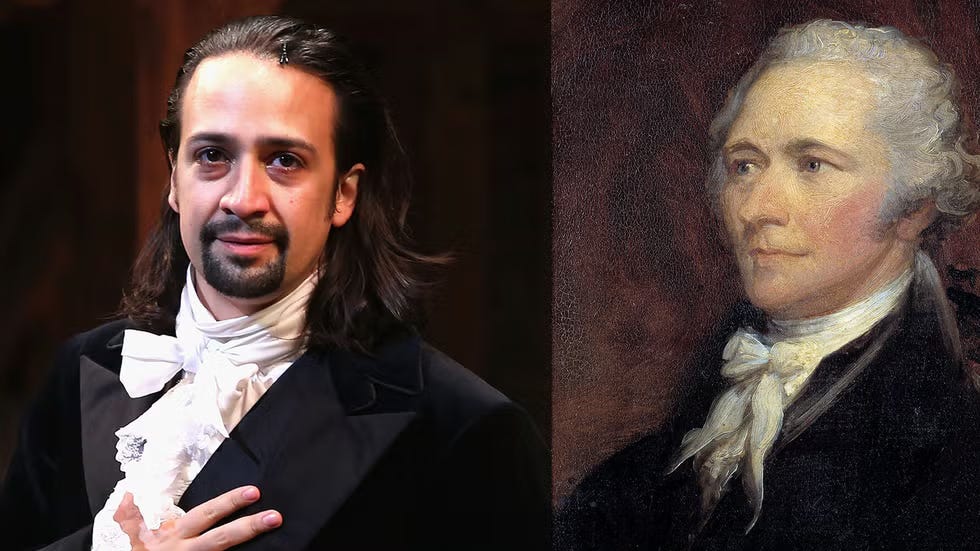
To my mind, evidence for one argument and none for the counterargument should settle the question. But narratives routinely survive the evidence against them, particularly once they acquire a soundtrack. Chernow has not revised Alexander Hamilton, nor has his publisher added a note incorporating Serfilippi’s findings. The book still presents Hamilton as fundamentally antislavery. Its most powerful adaptation remains unrevised, too. Lin-Manuel Miranda has acknowledged broader criticism of the musical’s treatment of slavery, but “Hamilton” continues without any corresponding change to the musical. Chernow’s version keeps singing.
Once missing documentation becomes blank space in which to sketch moral greatness, there is no limiting principle. The method can follow its author anywhere, including Miranda’s musical, which still presents the founder as comparatively enlightened—particularly beside Jefferson.
In 2025, Chernow exported its logic to another biography. In Mark Twain, proximity to slavery once again became proof that a white man who otherwise seemed great must have transcended it—in his heart, not in the archives. This is what I’ve come to call “magnolias under the moonlight bullshit:” domination enters the biography, passes through authorial wishful thinking, and exits as moral instruction. A brutal system becomes the setting for a white man’s enlightenment. The enslaved provide his character development.
The only meaningful movement in this story belongs to Serfilippi. She now serves as the lead interpreter at Schuyler Mansion. In 2022, the Journal of the Early Republic published her essay, “Up for Interpretation: The Historical Interpreter’s Role in Producing and Expanding Scholarship,” which made explicit what the dispute had already demonstrated: historical interpreters do not merely recite scholarship. They produce it.
Serfilippi’s evidence entered the historical record. Chernow’s wishful thinking entered another book. What should have prompted a correction instead revealed a pattern.
See you soonish! In the meantime, you can find me on Instagram and, on occasion, Bluesky and Twitter. My books are at Bookshop, Amazon, and your local bookstore or library. If you’d like me to sign or personalize my books, purchase copies from Oblong Books.
I find it interesting that in an era of history revisioning that Chernow’s subtle reinterpretation of history is coming to light now. Coincidence?